
Celebrating Nursing Week May 6 - 12 2013

The Ontario Council Of Hospital Unions represents over 30,000 healthcare workers in Ontario and is working to defend health services in every community.

OCHU's Top Stories

Stacks Image 585

Municipalities themselves are the problem, not the arbitration system

Don’t make war on health care workers to deal with a handful of police and fire awards
February 14, 2013
TORONTO, ON – Hospital and long-term care workers urged Ontario’s Premier today to question the claims of municipalities that misrepresent arbitration outcomes and ignore the fact that the majority of municipal essential service contracts are freely negotiated.
“Municipalities freely negotiate over 90 per cent of their essential service contracts. Only a small number go to arbitration. The municipalities’ call for changes to arbitration rings hollow and should be resisted by the Premier,” said Michael Hurley president of the Ontario Council of Hospital Unions (OCHU) the hospital division of the Canadian Union of Public Employees (CUPE) in Ontario...read more

Message to Ontario’s health minister: “It’s not OK” to cut 18,500 hospital beds

Graveyards full of dead patients the result of province’s decade-long experiment with bed closures
February 27, 2013
TORONTO, ON — Ontario’s pioneering experiment to change health care delivery — that includes the closing of 18,500 beds — is not “ok” and not a health policy that’s in the best interest of patient safety because there aren’t enough services in the home and community care sector to provide the extensive medical support many patients need, says Michael Hurley the president of the Ontario Council of Hospital Unions (OCHU).
Since the mid-90s 18,500 hospital beds have been cut in Ontario. Ontario’s hospital bed occupancy rate stands at 97.9 per cent — the highest among industrialized countries.
“This government’s fixation with cutting hospital beds and services is disproportionately affecting the elderly. Thousands of acutely ill seniors are pushed out hospital prematurely every year into a home and community care system where services simply don’t exist…read more
Stacks Image 48
If three jumbo jets crash, killing 1153 people every week, would government act?
That’s how many patients die weekly due to the epidemic of medical errors - May 10 2012
OTTAWA, ON - Research shows that 18 per cent of Canadian patients entering hospitals – 552,000 of them – experience harm, and between 56,000 and 63,000 (the equivalent of three jumbo jets crashing, killing all on board, every week) will die from a medical error or hospital-acquired infection, said the authors of a book that looks at the systemic causes of preventable hospital deaths, at an Ottawa media conference today. Medical errors include medication mistakes, misdiagnoses and unnecessary surgeries, as well as hospital-acquired infections...read more

City Must Open Shelter For The Homeless Now!

Stacks Image 56
March 25 2013 - TORONTO, ON –After weeks of determined community action to force the City to respond to the crisis of overcrowding in its shelter system, the Community Development and Recreation Committee met on March 18. Dozens of powerful deputations were presented by those with experience of homelessness, front line workers and advocates. Despite a staff report still trying to suggest that the shelters were adequate, the myth of a system that is coping with the needs of those on the streets died on the floor of that committee room. Its members called on Council to return to a policy of opening more shelter spaces when the system reached 90% capacity but, astoundingly, recommended only that 172 'flex beds' be opened. This means putting down mats on the floor of already overcrowded shelters and pushing capacity well beyond 96%...Click here to continue reading
Stacks Image 24

CBC Marketplace - Dirty Hospitals

Canada has the highest rate of hospital acquired infections in the developed world, and Canada's consumer watchdog wants to know why.
Erica Johnson puts hospital cleanliness to the test, and finds a mess that is making you sick. With hidden cameras, including Canada's first hidden camera glo gel test, insider interviews and expert opinions, Marketplace uncovers why people in Canadian hospitals are too often getting sicker instead of better.
Note: Marketplace went inside eleven hospitals in Ontario and British Columbia. We decided to only name the Niagara region hospitals because that is where there was a major C. difficile outbreak last year, that is where Gary Ball died, and those are the hospitals Dr. Kevin Smith supervises. Watch the episode...
Stacks Image 34
Local Issues Award released for hospital local unions participating in OCHU/CUPE central bargaining
The hearings on coordinated issues were held on October 20 and November 2, 2010,
at Toronto, followed by local hearings across the province and by executive sessions once the hearings on local issues were completed. The last executive session held thus far took place on October 15, 2011.
...read more
Stacks Image 42
Join the Ontario Coalition Against Poverty and Ontario Council of Hospital Unions at Mayworks Festival of Working People and the Arts 2012...
Poverty and Health: The Special Diet is a short video on the affects of poverty on health and specifically the provincial social assistance benefit known as the Special Diet Allowance that was recently gutted by the provincial government. It highlights the voices of people on social assistance, as well as frontline workers in the healthcare sector. The video is a joint project produced by the Ontario Council of Hospital Unions (OCHU) and the Ontario Coalition Against Poverty (OCAP) and was made to support the Raise the Rates campaign to demand a raise in welfare (Ontario Works) and disability (ODSP) rates in the province of Ontario.read more...
Enter the name for this tabbed section: Arbitration

Contract Arbitration Video

Stacks Image 67

OCHU/CUPE Radio Ad - English

Listen to CUPE Radio Ad - English

OCHU/CUPE Radio Ad - French

Listen to CUPE Radio Ad - French
Enter the name for this tabbed section: Perth and Smiths Falls
Perth, Smiths Falls residents urged to attend community meetings to stop hospital cuts
JANUARY 11, 2013
PERTH, ON – Following several weeks of community outreach providing Perth and Smiths Falls residents with details of big cuts to surgery and other service at the district hospitals, area health care workers and other local activists are urging area residents to attend one of two community meetings this coming Monday and Tuesday in Perth and Smiths Falls, respectively.
With an ageing and growing population, the Perth and Smiths Falls communities deserve more access to a full range of health services at the district hospital – not less – say meeting organizers; the Ontario Health Coalition (OHC) and the Ontario Council of Hospital Unions (OCHU)…read more
Stacks Image 1413
Listen to an interview with Michael Hurley on Lake88
Enter the name for this tabbed section: HAI Tour
Stacks Image 72
Provincial HAI Tour
Although medical experts are blaming hospital overcrowding (resulting from cuts to patient beds) for infection outbreaks – particularly outbreaks of antibiotic- resistant superbugs – the Ontario government plans to cut another 5,000 acute care beds province-wide. Currently, hospital bed occupancy is at record levels, over 97 per cent.

Studies show that healthcare-associated infections kill between 8,000 and 12,000 Canadians a year – 40 per cent of these deaths are in Ontario.

“Many of these deaths are preventable. Ontario should follow the lead of countries where hospital acquired infections have been significantly reduced by pro-active measures,” says Sharon Richer, the Vice-President of the Ontario Council of Hospital Unions (OCHU) of the Canadian Union of Public Employees (CUPE).

OCHU/CUPE’s mobile hospital room tour will be visiting 15 communities across central and southern Ontario beginning October 11. OCHU/CUPE represents 35,000 hospital workers province-wide...click here to get full details
Stacks Image 336
Conference on the Epidemic of Medical Errors & Hospital Acquired Infections in the US and Canada: The Systemic Causes

June 4, 2012 Isabel Bader Theatre, 93 Charles St. W. Toronto, ON

Registration: $250.00 For more information about the conference or to register: www.ochu.on.ca
* Every registrant will receive a copy of the book: “ Epidemic of Medical Error and Hospital Acquired Infection “

Presentations:
Keynote, Systemic Causes of Medical Error and Hospital • Acquired Infection: The Epidemic • Epidemiology of Medical Error and Infections • The Canadian Situation • Staffing and Medical Error and Hospital Infections • Factory Medicine • Shiftwork and its Malevolent Effects • Medical Errors and Hospital Infections: The Quebec Situation • Bullying and Medical Error • Ethics of Medical Errors in US and Canada • Injure a Healthcare Worker Injure a Patient: Connecting the Dots • Legal Issues that Conflict with Patient Safety • Medical Error and Infections to Special Populations • Panel discussion

Sponsored by The Ontario Council of Hospital Unions

Click here for more information and to register online
Enter the name for this tabbed section: Health and Poverty
Poverty in Ontario is steadily increasing, and while the rich are getting richer, the poor are losing their livelihoods, their homes and are having difficulty providing for themselves and others. With the financial crisis used as a catalyst to cut from those who make the least, attacks on the most vulnerable in our country are becoming more brazen and the financial gap between the rich and poor gets wider every day.

One cause of this increased wage gap is the cut to the Special Diet - a food supplement program which provided up to $250 a month for those who could not afford to eat healthy food. This program is being replaced by a system which would exclude a significant portion of those who were previously using it to ensure they had access to decent meals.
Enter the name for this tabbed section: Educationals
Stacks Image 88

Educational Teleconference Series


with Ethan Poskanzer
from the law firm of Sack Goldblatt Mitchell
September 19th, 2011 @ 7pm (eastern standard): Contracting Out
October 17th, 2011 @ 7pm (eastern standard): Medical Information
November 21st, 2011 @ 7pm (eastern standard): Changes to Health and Safety Legislation
January 16th, 2012 @ 7pm (eastern standard): Parental leave/Compassionate leave

View and download the flyer

October 2012: Membership Newsletter

Stacks Image 2448

Liberals move to end bargaining

The Ontario Liberals have drafted legislation that would end bargaining in the healthcare sector, end our right to binding arbitration to resolve contract disputes and give the government the power to write contract terms and impose them on healthcare workers.
CUPE held emergency meetings earlier in October to approve a campaign to push back. The union needs your help to: sign and mail the postcard that is included in this envelope; attend the lobby meeting organized by your union local with your local provincial member of parliament and attend the demonstration on November 28 at noon in Toronto. Buses are available....read more

Media Advisories

“Why are you attacking health care workers?”
April 10, 2012
North Bay, Sudbury nurses and health care staff ask at MPP Fedeli
rally tomorrow

North Bay, ON — Nurses and other health care workers whose jobs are too vital to allow them the right to strike will remind Nipissing MPP Vic Fedeli at a rally tomorrow (Thursday, April 11) that they are dedicated caregivers who deserve a fair and balanced process to resolve contract disputes.

“Health care arbitration has been less generous over the last 20 years than settlements bargained
in the private or public sector and claims otherwise are not true. But both the Liberals and the Conservatives are targeting the health care arbitration system for changes that will give employers the upper hand. What on earth have the women who slave to keep the health care system working done to deserve this?” says Henri Giroux a long-term care worker and the president of the North Bay and District CUPE Council\Labour.
“Health care arbitration covers far more staff — about 250,000 them, 85% women — than municipal services like police and firefighters. Generous arbitration outcomes for police and fire, which have been highlighted by Mr. Fedeli, can be tracked back to a freely negotiated settlement between the Ontario government and the provincial police several years ago. Lumping health care outcomes with police and fire is outrageous” says Mr. Giroux.
Last November, Giroux, health care workers and other constituents met with MPP Fedeli. They reviewed with him Ontario Ministry of Labour data showing that far from being exorbitant, in the hospital and long-term care sector, arbitrated settlements are more modest than freely negotiated settlements.
Ontario Council of Hospital Unions (OCHU) president Michael Hurley, a speaker at the rally tomorrow says, “the provincial government must resist changes to health care arbitration that would tip the balance in contract arbitration in favour of employers. If workers do not have confidence in the arbitration system because they believe it to be biased they will not use it and the very stability that arbitration is meant to provide will be lost. During the first term of the Harris government, both SEIU and CUPE moved towards illegal hospital strikes rather than submit to a corrupted arbitration system. The Harris government withdrew its changes to restore stability.”
Throughout decades-long service restructuring and downsizing, Ontario’s health sector workers are extremely dedicated and productive, says Hurley. “The result is that Ontario’s hospitals and long-term care homes are the most cost-effective in Canada. Is picking a fight with these health care workers — when their wage settlements have been responsible — and creating upheaval in essential health services really a top legislative priority for the Liberals and Conservatives? I would hope not.”
Thursday’s rally at Fedeli’s constituency office, 165 Main Street East, North Bay, begins at 11:30 a.m.

For more information, please contact:

Henri Giroux, President North Bay and District CUPE Council\Labour
(705) 471-7746

Michael Hurley, President Ontario Council of Hospital Unions
(416) 884-0770

Stella Yeadon, CUPE Communications
(416) 559-9300
Ontario LTC residents get one hour less care a day than rest of Canada
Health minister must act to increase personal care hours
March 28 2012

Families, long-term care staff at Queen’s Park rally today

TORONTO, ON – Following this month’s tragic homicide of a senior in a Toronto long-term care home, and “a decade-long string of unmet promises by successive Ontario health ministers to do better and make improvements to long-term care (LTC), the time to act to increase care hours and keep residents safer is now,” says Michael Hurley the president of the Ontario Council of Hospital Unions (OCHU) of the Canadian Union of Public Employees (CUPE).
For more than 10 years, CUPE/OCHU have called on the provincial government to increase personal care and staffing supports, for the nearly 80,000 long-term care residents.
Recent Statistics Canada data indicates that Ontario homes for the aged fall well short of staffing for homes for the aged in other provinces. On average, facilities for the elderly in Ontario provide almost one hour less care for each resident everyday compared with the Canada-wide level. That means there is 22.5 per cent more care Canada-wide than in Ontario where funding is $28.30 less per resident per day than the national average.
Hurley will be among several invited guest speakers at a Queen’s Park rally today organized by the Parent family whose 85-year-old mother – a resident in a Peterborough nursing home – was attacked by another resident this February and is now in a wheelchair. The Parents’ believe that understaffing at the facility was a contributing factor in the attack on their mother.
“Long-term care workers are doing all they can to provide quality care, to treat residents with dignity and keep them safe. But chronic under-staffing and a lack of a provincial staffing standard, is leaving people vulnerable. Many incidents of resident-on-resident violence are preventable,” says Hurley.
A recent W5 investigation found that resident-on-resident violence in nursing homes is prevalent and on the rise across Ontario and the rest of Canada. It’s estimated that up to 75 per cent of residents have behavioral problems or are cognitively impaired.
In 2005 a coroner's jury into the 2001 death of two residents at Casa Verde (a Toronto nursing home) who were killed by another resident made 85 recommendations – several of them focused on sweeping changes to improve resident safety including increasing staffing and care levels and locked units for residents with dementia. Few of the recommendations have been acted on.
“While we have no doubt, Ontario’s health minister takes her responsibility as the minister responsible for care in long-term care homes extremely seriously the lack of action to make homes safer is extremely worrisome,” says Hurley.


For more information please contact:

Michael Hurley
President Ontario Council of Hospital Unions (OCHU-CUPE) 416-884-0770

Stella Yeadon
CUPE Communications
416-559-9300

Excessive corporate rights in Canada-EU trade deal are unacceptable to broad section of European, Canadian and Quebec society
February 5 2013
Brussels, Ottawa and Montreal – Labour, environmental, Indigenous, women’s, academic, health sector and fair trade organizations from Europe, Canada and Quebec representing more than 65 million people are demanding that Canada and the EU stop negotiating an excessive and controversial investor rights chapter in the proposed Comprehensive Economic and Trade Agreement (CETA). The groups issued a joint statement today ahead of a two-day meeting in Ottawa between European Trade Commissioner Karel De Gucht and Canadian International Trade Minister Ed Fast, where the two hope to move the CETA negotiations forward if not to conclude an agreement.

“We will vigorously oppose any transatlantic agreement that compromises our democracies, human and Indigenous rights, and our right to protect our health and the planet,” says the transatlantic statement, endorsed by more than 70 organizations. “We urge the EU and Canadian governments to follow the lead of the Australian government by stopping the practice of including investor-state dispute settlement in their trade and investment agreements, and to open the door to a broad re-writing of trade and investment policy to balance out corporate interests against the greater public interest.”

Investor-state dispute settlement is a process found in many Canadian and European trade and investment agreements, including NAFTA and the hundreds of bilateral investment treaties that EU members states have signed with developing countries and with each other. The process allows a firm in one country to sue the government of the other country if the firm feels its investor rights have been violated. In a very real sense, these investment rules create a parallel legal system for multinational corporations and private investors, who are using them increasingly to challenge environmental, public health and other government policies, decisions, laws and measures that interfere in some way with the “right” to make a profit.

Recent high-profile cases include the $250-million NAFTA lawsuit threatened by Lone Pine Resources against Quebec’s ban on hydraulic fracturing (“fracking”), a €3.7-billion claim by Swedish Energy firm Vattenfall against Germany’s decision to phase out nuclear power, ExxonMobil and Murphy Oil’s successful case against provincial profit-sharing rules on offshore oil development, and U.S.-based Renco Group’s $800-million claim against a Peruvian requirement to clean up the extreme pollution caused by its smelter in La Oroya.

“Qualitative research suggests that the treaties are not a decisive factor in whether investors go abroad... Based on a lack of economic benefits, and evidence that investment treaties do pose risks to environmental measures, a Sustainability Impact Assessment of CETA urged the European Union not to include [investor-state dispute settlement] in the agreement. Like the European Parliament, this independent report for the European Commission suggested a state-to-state dispute process is more appropriate in the EU-Canada context,” says the joint statement issued today by transatlantic civil society groups.

The Australian government decided in 2011 it would stop including these rights and investor-state dispute settlement in its trade and investment agreements. Many countries, including South Africa and India, are rethinking their investment treaties because of the way corporations and law firms have abused them to undermine democracy and public policies globally. Several Latin American countries are cancelling their investment treaties for the same reason.

In 1998, European and Canadian opposition to investor-state dispute settlement put an end to the planned Multilateral Investment Agreement, which would have extended these extreme investor protections to the entire OECD region. In the same spirit and in light of the rebirth of this failed corporate project in the Canada-EU trade deal, the European, Canadian and Quebec groups listed below “demand that the EU and Canada cease negotiating investor rights and an investor-state dispute settlement process into the CETA.”

To read the full statement: http://tradejustice.ca

Endorsed in Europe: 11.11.11 (Belgium), AITEC (France), ACV-CSC (Belgium), Attac Austria (Austria), Attac-France (France), Attac Liège (Belgium), ATTAC VLAANDEREN (Belgium), Both Ends (Netherlands), Center for Research and Documentation Chile-Latin America (Germany), CFTC, Confédération française des travailleurs chrétiens (France), CNCD – 11.11.11 (Belgium), Corporate Europe Observatory (Belgium), Ecologistas en Aciòn (Spain), European Federation of Public Services Unions (EPSU), European Trade Union Confederation (ETUC), Fairwatch (Italy), Food & Water Europe, Foundation for a Free Information Infrastructure (FFII – Germany), FTM-CGT (France), Global Social Justice (Belgium), International Trade Union Confederation (ITUC), Labour, Health and Human Rights Development Centre (Nigeria), PowerShift (Germany), Stichting Vrijschrift (Netherlands), SOMO (Netherlands), Transnational Institute (Netherlands), World Economy, Ecology & Development (Germany), Zukunftskonvent (Germany)

Endorsed in Canada: Canadian Association of University Teachers, Canadian Auto Workers, Canadian Environmental Law Association, Canadian Federation of Students (CFS-FCEE), Canadian Health Coalition, Canadian HIV/AIDS Legal Network, Canadian Union of Postal Workers (CUPW), Canadian Union of Public Employees (CUPE), Common Frontiers, Communications, Energy and Paperworkers Union of Canada (CEP), Council of Canadians, Greenpeace Canada, Hupacasath First Nation, National Farmers Union, National Union of Public and General Employees, Ontario Council of Hospital Unions, Polaris Institute, Public Service Alliance of Canada, Registered Nurses’ Association of Ontario, Sierra Club Canada, (Tsalalh) Seton Lake Indian Band, Trade Justice Network, United Steelworkers

Endorsed in Quebec: Réseau québécois sur l’intégration continentale (RQIC), Alliance du personnel professionnel et technique de la santé et des services sociaux (APTS), Alternatives, Association canadienne des avocats du mouvement syndical (ACAMS-CALL), Association québécoise des organismes de coopération internationale (AQOCI), Attac-Québec, Centrale des Syndicats démocratiques (CSD), Centrale des Syndicats du Québec (CSQ), Confédération des Syndicats nationaux (CSN), Conseil central du Montréal métropolitain (CCMM-CSN), Eau Secours!, Fédération des femmes du Québec (FFQ), Fédération étudiante collégiale du Québec (FECQ), Fédération étudiante universitaire du Québec (FEUQ), Fédération interprofessionnelle de la santé du Québec (FIQ), Fédération des travailleurs et travailleuses du Québec (FTQ), Ligue des droits et libertés, Mouvement d’éducation populaire et d’action communautaire du Québec (MÉPACQ), Réseau québécois des groupes écologistes (RQGE), Syndicat canadien de la fonction publique section Québec (SCFP-Québec), Syndicat de professionnelles et professionnels du gouvernement du Québec (SPGQ), Union des consommateurs

-30-

For more information: http://tradejustice.ca

Bruno Ciccaglione, Seattle to Brussels network: bruno.ciccaglione@alice.it
Pierre-Yves Serinet, Réseau québécois sur l'intégration continentale (RQIC): +1 (514) 276-1075; rqic@ciso.qc.ca
Stuart Trew, Trade Justice Network: +1 (647) 222-9782; TJN.RCJ@gmail.com
What have Ontario seniors done to earn the wrath of the Ontario government?
January 18, 2013

TORONTO, ON – “While talking a good line” on providing care for Ontario’s legion of growing seniors, Ontario’s health minister “continues to short-change health care access for older Ontarians and fudge the facts of her government’s go-forward plan to replace universal and comprehensive hospital services and long-term care with limited home care supports,” charges Canadian Union of Public Employees (CUPE) Ontario president Fred Hahn in response to a series of recent Liberal government announcements.

“Platitudes from the health minister and a couple of hours a week of home care aren’t going to provide a senior with multiple chronic conditions and little mobility with the 24-hour care and the quality of life they deserve,” says Hahn.

Last month’s Ontario auditor’s report tells the real story about seniors’ care. He found that 15 per cent of the nearly 20,000 people waiting for a long-term care (LTC) bed die while on the wait list for a bed. According to the auditor, since 2004/05 the number of people waiting for a bed has increased 85 per cent, despite stricter eligibility requirements coming into force in 2010. Over the same period the number of LTC beds in Ontario has increased by just 3 per cent.

Another 10,000 Ontarians are waiting for care at home. But funding for home care - home support and nursing - are set at levels “far too low to meet the existing waiting lists and new need from hospital offloading of more complex patients,” says Michael Hurley, the president of CUPE’s Ontario Council of Hospital Unions (OCHU). Already Ontario has among the lowest per person health care funding in Canada. Over the next few years when Ontario’s population is ageing at unprecedented rate, the Liberals intend to cut billions of dollars more from health services.

What’s clear, Hurley says, is that hospital beds providing services to seniors in hospital are aggressively being cut across Ontario. Also being cut, are in-hospital physiotherapy and speech therapy programs, many serving seniors, which are being privatized in the community. “We also have a means-tested drug plan for seniors coming. It begs the question what have Ontario seniors done to earn the wrath of the Ontario government?” Asks Hurley.

As part of a “new” seniors’ health strategy, the government is looking at means-tested co-payments for the provision of home care and community support services.

Hahn says that “there appears a willful blindness on the part of the health minister, her government and those charged with developing a plan for seniors’ care, that verges on disrespect for the people who have built this province. What would be genuine and respectful is, the new Liberal premier stopping the billions of dollars in health service cost-cutting at the expense of care for seniors.”


For more information please contact:
Fred Hahn
President, CUPE Ontario
416-540-3979

Michael Hurley President,
Ontario Council of Hospital Unions (OCHU/CUPE)
416-559-9300

Stella Yeadon
CUPE Communications
416-559-9300
St. Joe’s health care workers urge chief coroner attending Hamilton dinner today for inquest into beating death of psychiatric patient
January 15 2013
HAMILTON, ON – Ontario’s chief coroner Dr. Andrew McCallum is the guest speaker at a Hamilton Medical-Legal Society fund raising dinner today, January 15 where he will focus on inquest and death review leading to changes. While St. Joseph’s health care workers are not attending the event tonight, they are hopeful Dr. McCallum will revisit initiating an inquest into the tragic May 2012 beating death of Michael Brewer, a forensic psychiatric patient at the hands of another patient at the facility.

Following Brewer’s death the Ontario Council of Hospital Unions (OCHU) of the Canadian Union of Public Employees (CUPE) 786 representing 350 registered practical nurses and nearly 700 other support staff at St. Joe’s, wrote Dr. McCallum requesting that the coroner’s office immediately initiate an inquest similar to what occurs following a death in a corrections facility. OCHU/CUPE drew attention to workplace conditions, specifically the lack of security, understaffing and overcrowding that may be contributing factors in this death.

In an officious response, the regional supervising coroner for the Hamilton region wrote that a decision regarding the necessity of a “discretionary inquest into the circumstances of this death will be made at the completion of the investigation and, should an inquest be called, it cannot proceed until criminal matters are complete and the appeal process is finished.”

While the hospital administration has improved some aspects of security, little has changed, says CUPE 786 president Domenic DiPasquale.

“It was very disappointing to receive a response from the coroner’s office that an inquest in this case was discretionary and that it would not happen until all the legal proceedings were done. That could take years. In the meantime little is done to prevent a similar incidence from happening again,” says DiPasquale, who points out that several years ago a nurse was severely beaten by a patient and the hospital continues to report monthly first aid incidents involving nurses.

Although Dr. McCallum is moving on from the coroner’s office to head up Ontario’s scandal-plagued air ambulance service, DiPasquale says, “in light of the topic of his speech tonight,
we think his office should reconsider our request for an inquest.”

Tonight’s Hamilton Medical-Legal Society dinner begins at 7 p.m. at Spencer’s at the Waterfront, 1340 Lakeshore Road, Burlington.

For more information please contact:

Stella Yeadon
CUPE Communications
416-559-9300
Perth, Smiths Falls residents urged to attend community meetings to stop hospital cuts
JANUARY 11, 2013
PERTH, ON – Following several weeks of community outreach providing Perth and Smiths Falls residents with details of big cuts to surgery and other service at the district hospitals, area health care workers and other local activists are urging area residents to attend one of two community meetings this coming Monday and Tuesday in Perth and Smiths Falls, respectively.
With an ageing and growing population, the Perth and Smiths Falls communities deserve more access to a full range of health services at the district hospital – not less – say meeting organizers; the Ontario Health Coalition (OHC) and the Ontario Council of Hospital Unions (OCHU).
The proposed cuts amounting to $4 million that include the closure of 12 beds are not a done deal, says OCHU president, Michael Hurley. He’s urging area residents to attend one of the two important community meetings planned for this Monday, January 14 at 7 p.m. at the Perth Civitan Club, and
on Tuesday, January 15 at 7 p.m. at the Smiths Falls Legion Hall.
After many years of defending access to public health care across Ontario, OHC chair Natalie Mehra believes community mobilizing is key to keeping local hospital services. She says, because the provincial government intends to decrease health care funding over the next five years, the community’s ability to mobilize to maintain access to surgeries and other services at the Perth and Smiths Falls District Hospital today “is a litmus test” for what may happen to hospital services in the future. Mehra is encouraging area residents to attend next week’s meetings and “help stop the cuts”.
OCHU is the hospital division of the Canadian Union of Public Employees (CUPE) in Ontario. CUPE represents nearly 70,000 health care workers province-wide.

For more information please contact:

Michael Hurley
President, Ontario Council of Hospital Unions 416-884-0770

Natalie Mehra
Chair, Ontario Health Coalition
416-230-6402

Stella Yeadon
CUPE Communications
416-559-9300
“Protect Ontarians, tell us who they are.”
Health minister urged to name clinics providing subpar, inferior care

TORONTO, ON – Today’s report – the first of its kind – that found nine private medical procedures clinics are providing subpar, inferior care and that over a quarter of them are deficient in some way, should be a wake-up for Ontario’s Liberal government poised to aggressively expand the private clinic model, says Michael Hurley, president of the Ontario Council of Hospital Unions (OCHU).

To better protect Ontarians the health minister must first “tell us who they are.” While letting the public know the names of the clinics providing “slip-shod, unsafe procedures is a first step,” Hurley says the provincial government must do more, including making the now voluntary inspections, compulsory.

“The inspection report raises many questions about the health and safety risks for patients accessing medical procedures like colonoscopies outside of hospital at private clinics. Ontarians should be greatly concerned that the health minister is effusive about closing hospital clinics while opening new shopping mall-based clinics like kidney dialysis centers. Low-rent, cut-rate health services at the local mall may not be the best way to deliver quality care and protect patients from risks,” says Hurley. Research clearly shows that death rates are higher at private, for-profit dialysis clinics, he adds.

Ontario’s public hospitals are subject to intense scrutiny, and regulatory and inspection processes intended to keep patients safe. Hospitals must now report the rates of hospital acquired infections (HAIs). There is no similar reporting required for private clinics. “A patient going in to have cataract surgery at one of these private clinics – which do receive public health care money – has no idea what the clinic’s rate of infection is or how many surgeries go awry. There is simply no transparency,” says Hurley.

Increasing provincial regulatory oversight would better protect Ontarians from unsafe practices at existing private medical procedure clinics, Hurley says. Inspections should also be done by a provincial ministry or agency, not a regulatory college for doctors, since doctors are often the primary owner-operators of these private clinics. “The inspection system we have now is akin to putting the fox in charge of the hen house,” says Hurley.

OCHU has, for many years campaigned for lower HAI death rates and advocated for increased hospital transparency and accountability in the reporting of HAI rates.

-30-
For more information please contact:

Michael Hurley President,
Ontario Council of Hospital Unions (OCHU) 416-884-0770

Stella Yeadon
CUPE Communications 416-559-9300
Toronto health care workers rally in Toronto

Wednesday, November 28 to defend impartial arbitration
Urge those running for Liberal leadership to move away from failed policies attacking workers’ rights

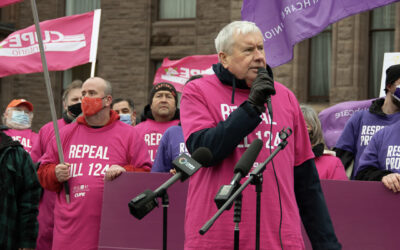
TORONTO, Ont. – Busloads of health care workers from across Ontario will converge for a rally in Toronto this Wednesday, November 28, 2012 at 12:00 noon at the Ministry of Finance (southeast corner Grosvenor and Queen’s Park Crescent). They will be joined by health sector staff and other public sector workers from across Ontario at the Wednesday rally focused on defending impartial interest arbitration and free collective bargaining for over 250,000 essential health care workers.

Health sector arbitration is working well and shouldn’t be attacked. The government’s intrusion into a stable, neutral process like arbitration “threatens these efforts and the public services Ontarians rely on,” says Michael Hurley, the president of the Ontario Council of Hospital Unions (OCHU).

A review of private-sector and public-sector collective agreements for the last 20 years found that compensation increases in the health sector are slightly below those of other sectors. Furthermore, health sector arbitrated settlements are modest, keep pace with inflation, and are less generous than for other essential service workers.

“Liberal leadership candidates are being urged to focus on economic recovery and job creation, rather than on public sector restraint policies that hinge on taking away workers’ rights and changing arbitration so it is no longer independent of government involvement,” says Hurley. To date, only a few of the leadership candidates have indicated that they would restore collective bargaining rights for education sector workers taken away under Bill 115 and not pursue similar legislation for other public sector workers.

“Regrettably, none of the candidates have said that, if they become Premier, they won’t pursue changes to the arbitration system. If rebranding is truly a goal for the Liberals, then stepping back from some of these ideas that have been disastrous for them would set them on a better course,” says Hurley.

For their part, the opposition Tories say they are pursuing radical changes to arbitration that would remove all neutrality from the process. Inherently, this is an issue of fairness for health care workers who have been provided with a fair arbitration process because, under law, they do not have the right to strike,” says Hurley.

OCHU is the hospital division of CUPE in Ontario which represents over 75,000 essential health sector staff at long-term care homes and hospitals across the province.

-30-

For more information, please contact:

Michael Hurley
President OCHU
(416) 884-0770

Stella Yeadon
CUPE Communications
(416) 559-9300
    Sign up for our newsletter
    * indicates required
Stacks Image 224
OCHU Secretary-Treasurer Helen Fetterly is vice-chair of the Board of Trustees for the Healthcare of Ontario Pension Plan (HOOPP) for 2012, as well as Chair of the Governance & HR Committee. Fetterly will move to the position of Board chair in 2013.

OCHU Links


OCHU/CUPE Contact